


Description
Introduction
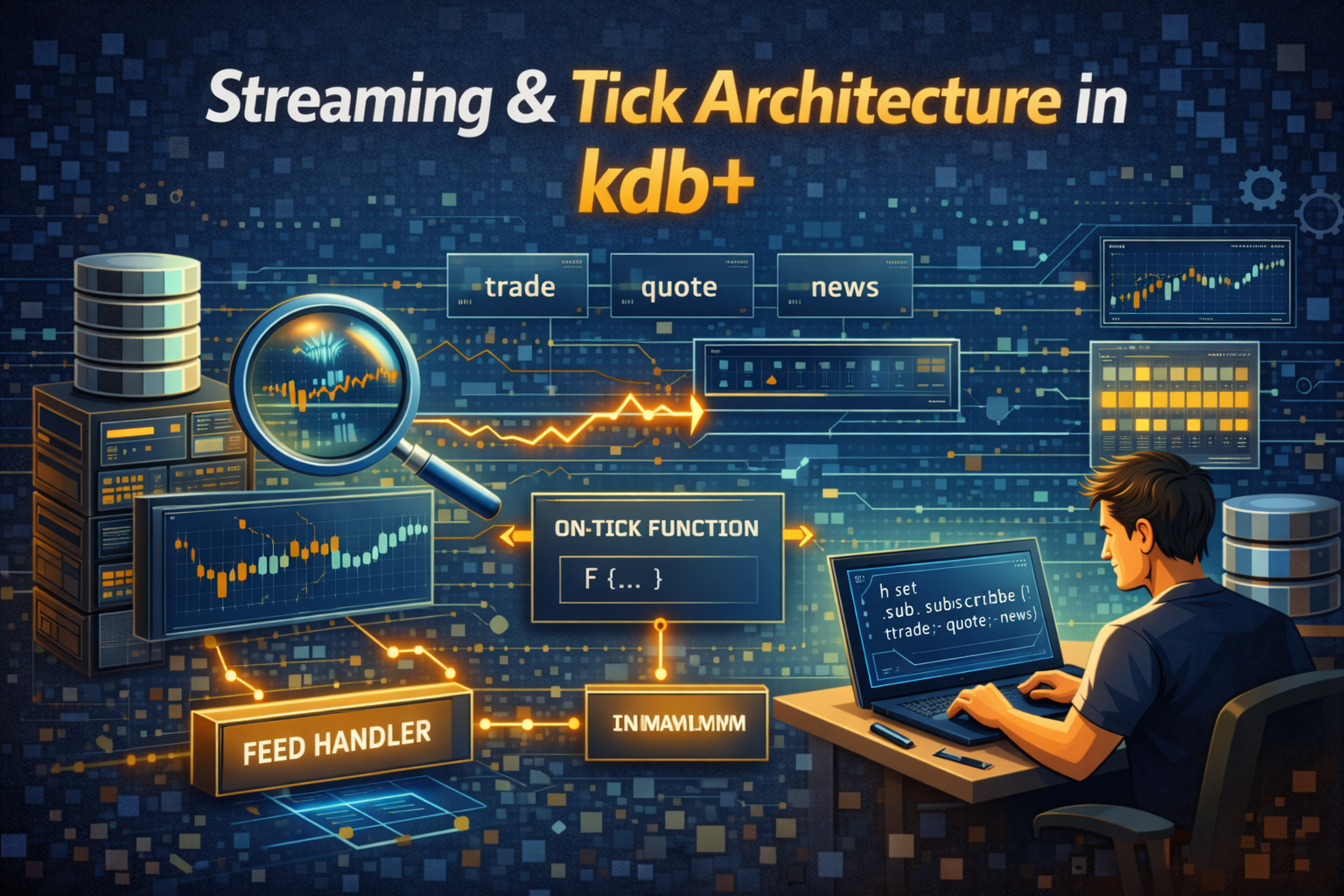
In high-frequency and real-time data environments, the ability to ingest, process, and analyze streaming data with ultra-low latency is critical. Streaming & Tick Architecture in kdb+ is designed to provide a deep, hands-on understanding of real-time data pipelines using kdb+ and the q language.
This training explores the core concepts of tick architecture — including tickerplants, real-time databases (RDB), historical databases (HDB), and logging mechanisms — enabling participants to build scalable, fault-tolerant, and high-performance streaming systems.
Participants will gain practical expertise in designing, implementing, and optimizing streaming pipelines suitable for financial markets, IoT, telecom, and other time-series intensive industries.
Prerequisites
- Basic understanding of kdb+ & q fundamentals
- Knowledge of tables, lists, dictionaries, and functions in q
- Understanding of time-series data concepts
- Familiarity with Linux command line (preferred)
- Basic networking concepts (IPC, client-server architecture)
- kdb+ & q Fundamentals
- Time-Series Data Modeling in kdb+
Table of Contents
Module 1: Foundations of Streaming in kdb+
- Real-time vs Batch Processing
- Overview of Tick Architecture
- kdb+ Process Roles and Communication
- IPC Mechanisms in q
- Publishing & Subscribing Model
Module 2: The Tickerplant (TP)
- Role of the Tickerplant
- Schema Design for Streaming Data
- Writing a Basic Tickerplant
- Logging & Data Persistence
- Managing Subscriptions
- End-of-Day (EOD) Processing
Module 3: Real-Time Database (RDB)
- RDB Architecture and Responsibilities
- Subscribing to the Tickerplant
- In-Memory Data Management
- Handling Intraday Queries
- Performance Considerations
- Restart & Recovery Strategies
Module 4: Historical Database (HDB) Integration
- Data Lifecycle in Tick Architecture
- EOD Data Migration (RDB → HDB)
- Partitioning Strategies
- Splayed & Partitioned Tables
- Querying Across RDB and HDB
Module 5: Building a Complete Tick System
- Process Topology Design
- Multi-Asset & Multi-Feed Setup
- Load Balancing Techniques
- Chained Tickerplants
- Data Replay & Backfilling
Module 6: Advanced Streaming Patterns
- Derived & Calculated Streams
- Real-Time Aggregations
- Windowed Analytics
- Alerting & Event Processing
- Complex Event Processing (CEP) in q
Module 7: Performance Optimization
- Latency Measurement & Monitoring
- Memory Optimization Techniques
- Efficient Table Design
- Asynchronous vs Synchronous Processing
- Scaling Strategies (Vertical & Horizontal)
Module 8: Fault Tolerance & Production Deployment
- High Availability Architectures
- Replication & Failover Strategies
- Logging & Auditing
- Monitoring & Health Checks
- Deployment Best Practices
Module 9: Hands-On Labs & Capstone
- Build a Live Market Data Simulation
- Implement a Production-Ready Tick Architecture
- Real-Time Trade & Quote Analytics
- End-to-End Deployment Exercise
Reviews
There are no reviews yet.