


Description
Introduction
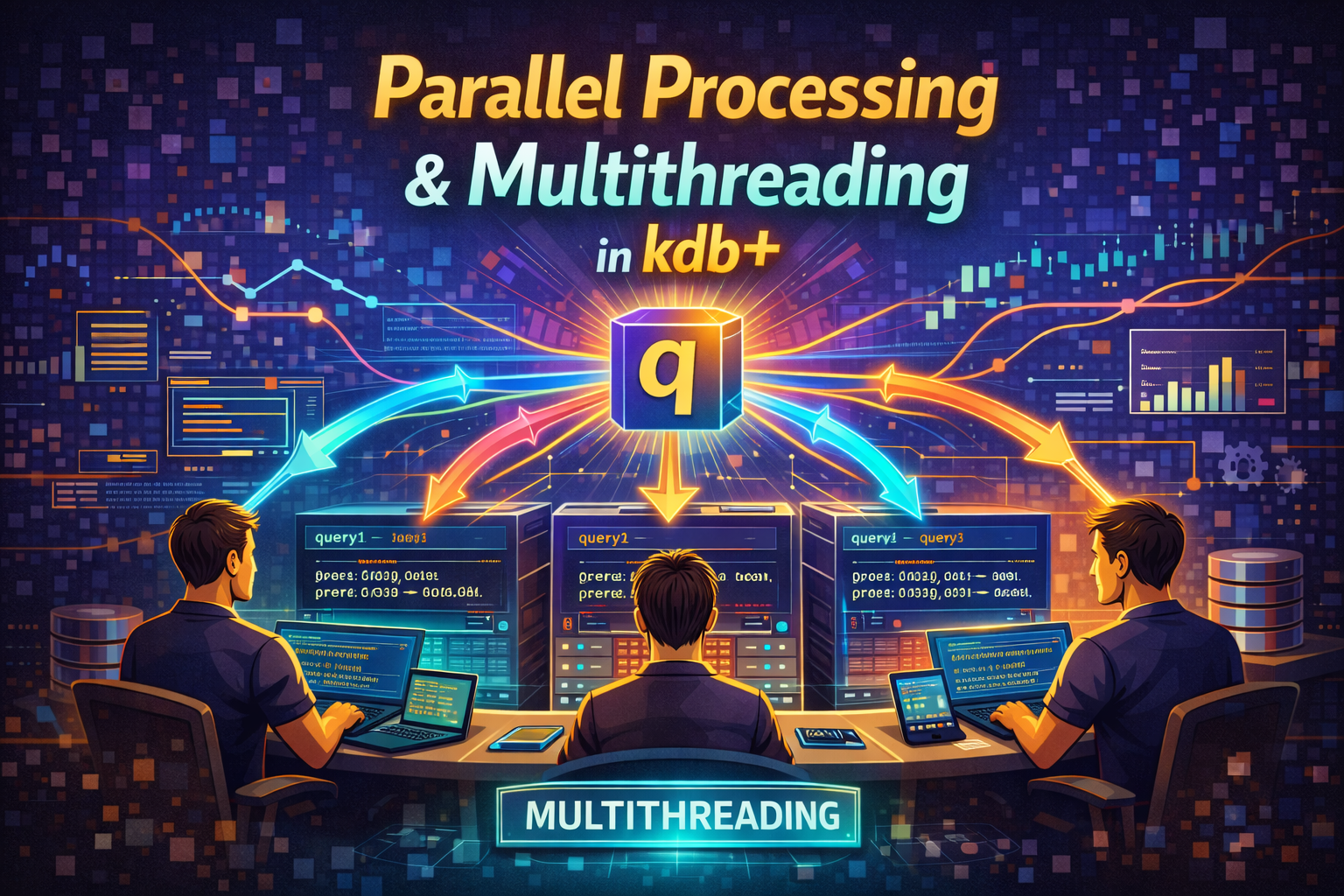
Modern financial and real-time analytics systems demand ultra-low latency and high-throughput data processing. kdb+, powered by the q language, is designed to efficiently handle massive time-series datasets — but to fully leverage modern multi-core architectures, understanding parallel processing and multithreading is essential.
This training provides a deep dive into how parallelism works in kdb+, including internal multithreading, secondary threads, peach (parallel each), parallel query execution, and distributed workload strategies. Participants will learn how to design high-performance systems that scale across cores and processes while maintaining data integrity and minimal latency.
By the end of this course, attendees will be able to build optimized, multi-core enabled kdb+ solutions suitable for trading systems, real-time analytics, and enterprise-scale data platforms.
Prerequisites
- Basic understanding of kdb+ architecture
- Working knowledge of q programming
- Experience with:
- Tables, lists, dictionaries
- Select queries and aggregations
- Familiarity with:
- In-memory vs on-disk databases
- IPC basics in kdb+
- Basic understanding of operating system concepts (processes vs threads)
- kdb+ Fundamentals: Time-Series Database Essentials
- Advanced q Programming Techniques
- Inter-Process Communication (IPC) in kdb+
Table of Contents
Module 1: Foundations of Parallelism in kdb+
- Understanding concurrency vs parallelism
- Processes vs threads in kdb+
- kdb+ process model
- Multi-core architecture basics
- Threading limitations and design philosophy in kdb+
Module 2: Built-in Multithreading in kdb+
- Secondary threads in kdb+
- Configuring
-s(number of secondary threads) - Thread-safe operations
- Internal multithreaded primitives
- Performance characteristics and caveats
Module 3: Parallel Execution with peach
- Understanding
eachvspeach - When to use
peach - Practical examples with large datasets
- Performance benchmarking
- Memory considerations and pitfalls
Module 4: Multithreaded Queries
- Parallel select queries
- Multithreaded aggregations
- Partition-wise parallelism
- Attribute usage for performance
- Real-world query tuning examples
Module 5: Asynchronous & Deferred Execution
- Async function calls
- Event-driven execution
- Non-blocking operations
- Callback mechanisms
- Combining async with multithreading
Module 6: Parallel Processing in HDB & RDB
- Partition-level parallelism
- Querying large historical databases
- Real-time + historical hybrid queries
- Scaling across cores
Module 7: Distributed Parallelism
- Multi-process architecture
- Task distribution using IPC
- Load balancing strategies
- Map-reduce style processing in kdb+
- Building scalable distributed analytics systems
Module 8: Performance Tuning & Benchmarking
- Measuring execution time (
\t,\ts) - CPU vs memory bottlenecks
- Avoiding false sharing & contention
- Optimizing memory usage
- Practical performance lab
Module 9: Best Practices & Design Patterns
- Safe parallel design patterns
- When NOT to use multithreading
- Debugging concurrent systems
- Production deployment considerations
- Case studies from financial systems

Reviews
There are no reviews yet.