


Description
Introduction
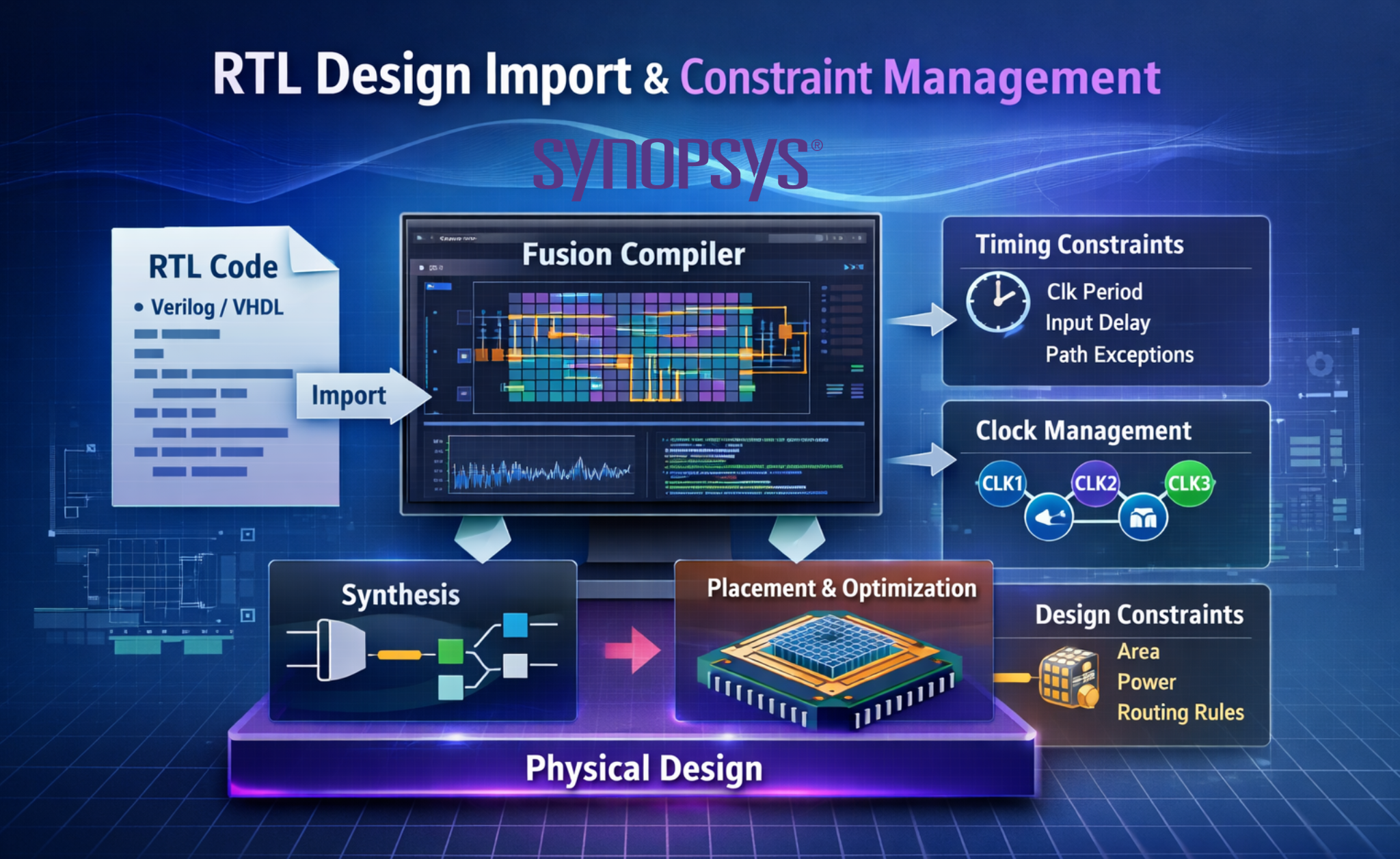
RTL Design Import & Constraint Management in Synopsys Fusion Compiler focuses on the early stages of physical design. In this phase, RTL is imported into the implementation environment. At the same time, constraints are defined to guide synthesis, placement, and optimization.
This training provides a structured approach to design initialization. Moreover, it explains constraint creation and timing intent in detail. As a result, learners can build a robust and convergent design flow.
Learner Prerequisites
- Basic understanding of digital design and RTL concepts such as Verilog or VHDL
- Familiarity with synthesis and static timing analysis fundamentals
- Knowledge of the semiconductor design flow from front-end to back-end
- Basic exposure to EDA tools and Linux environments
- Understanding of timing constraints and clocking concepts
Table of Contents
1. RTL Design Import Fundamentals
1.1 Overview of Fusion Compiler design flow
1.2 Understanding RTL handoff and design inputs
1.3 Supported RTL formats and coding guidelines
1.4 Importing RTL into the Fusion Compiler environment
1.5 Handling hierarchical versus flat designs
1.6 Design elaboration and initial checks
1.7 Debugging RTL import issues
1.8 Managing multi-file and multi-language designs
2. Library and Technology Setup
2.1 Technology file and library overview
2.2 Logical versus physical libraries
2.3 Milkyway/NDM library setup
2.4 Linking standard cell and memory libraries
2.5 Handling multi-voltage and multi-Vt libraries
2.6 Library consistency checks
2.7 Corner and variation setup
2.8 Best practices for library management
3. Design Initialization and Environment Setup
3.1 Creating design environments and workspaces
3.2 Setting up design variables and paths
3.3 Floorplan awareness during the import stage
3.4 Initial design checks and validation
3.5 Managing design hierarchy and modules
3.6 Handling black boxes and IP integration
3.7 Importing UPF/CPF for power intent
3.8 Version control and design data management
4. Constraint Management Fundamentals
4.1 Importance of constraints in physical design
4.2 Types of constraints in Fusion Compiler
4.3 Overview of Synopsys Design Constraints (SDC)
4.4 Constraint flow across design stages
4.5 Constraint validation and debugging
4.6 Common constraint issues and fixes
4.7 Best practices for constraint definition
4.8 Constraint reuse across projects
5. Clock Definition and Management
5.1 Creating primary clocks
5.2 Generated and derived clocks
5.3 Clock latency and uncertainty
5.4 Clock groups and relationships
5.5 Handling multiple clock domains
5.6 Asynchronous and synchronous clocks
5.7 Clock gating constraints
5.8 Debugging clock definition issues
6. Timing Constraints and Exceptions
6.1 Input and output delay constraints
6.2 Setup and hold timing constraints
6.3 False paths and multicycle paths
6.4 Maximum and minimum delay constraints
6.5 Case analysis and conditional constraints
6.6 Path-based versus graph-based analysis
6.7 Timing exception best practices
6.8 Debugging timing violations
7. Physical and Design Constraints
7.1 Area and utilization constraints
7.2 Placement constraints and regions
7.3 Blockages and keep-out margins
7.4 Routing constraints overview
7.5 Pin placement constraints
7.6 Congestion-aware constraints
7.7 Power and ground constraints
7.8 DRC and LVS considerations
8. Multi-Corner Multi-Mode (MCMM) Setup
8.1 MCMM concepts and importance
8.2 Defining modes and corners
8.3 Scenario creation in Fusion Compiler
8.4 Constraint management across scenarios
8.5 Timing analysis in MCMM environments
8.6 Optimization challenges in MCMM
8.7 Debugging MCMM setup issues
8.8 Best practices for convergence
9. Constraint Validation and Debugging
9.1 Constraint consistency checks
9.2 Using reports for verification
9.3 Identifying missing or conflicting constraints
9.4 Debugging timing and functional issues
9.5 Constraint coverage analysis
9.6 Automation and scripting for validation
9.7 Common pitfalls in constraint definition
9.8 Signoff readiness checks
10. Automation and Scripting
10.1 TCL scripting basics for Fusion Compiler
10.2 Automating RTL import flows
10.3 Script-based constraint creation
10.4 Batch versus interactive mode
10.5 Reusable scripts and templates
10.6 Debugging scripts and logs
10.7 Integration with CI/CD flows
10.8 Best practices for automation
11. Integration with Synthesis and Physical Design
11.1 Constraint handoff to synthesis
11.2 Consistency between RTL and netlist constraints
11.3 Interaction with placement and optimization
11.4 Early timing analysis and feedback loops
11.5 Cross-stage constraint alignment
11.6 Handling ECOs and design changes
11.7 Incremental constraint updates
11.8 Best practices for smooth integration
12. Advanced Topics in Constraint Management
12.1 Power-aware constraints
12.2 Low-power design using UPF/CPF
12.3 Handling complex SoC designs
12.4 Constraint partitioning for large designs
12.5 Hierarchical constraint management
12.6 Machine learning in constraint optimization
12.7 Advanced debugging techniques
12.8 Industry case studies
Conclusion
This training builds a strong foundation in RTL import and constraint management. It also helps learners define accurate timing intent. Furthermore, it ensures a smooth transition into physical design stages. As a result, designers can achieve faster convergence and better design quality.

Reviews
There are no reviews yet.