


Description
Introduction:
Synopsys TestMAX is an advanced Design-for-Test (DFT) solution. It is widely used for scan insertion, test point insertion, compression, and ATPG readiness in modern ASIC and SoC flows. Moreover, it enables automated transformation of RTL or gate-level designs into testable structures.
In addition, it improves fault coverage while optimizing silicon area, power, and test cost. Therefore, it supports scalable DFT architectures and hierarchical designs. As a result, it ensures high-quality production testing and faster time-to-silicon.
Learner Prerequisites:
- Basic understanding of digital logic design
- Familiarity with RTL coding (Verilog/SystemVerilog)
- Knowledge of DFT concepts such as scan chains, stuck-at faults, and ATPG
- Awareness of ASIC design flow
Table of Contents
1. Introduction to Scan Insertion & TestMAX Flow
1.1 Overview of DFT and Scan-Based Testing
1.2 Role of TestMAX in Scan Insertion Flow
1.3 Scan Insertion Objectives and Benefits
1.4 Design Readiness for Scan Implementation
1.5 Integration with RTL-to-GDSII Flow
2. Scan Architecture Fundamentals
2.1 Scan Cell Structure and Operation
2.2 Scan Flip-Flop Design and Variants
2.3 Scan Chain Formation and Ordering
2.4 Scan Enable and Test Modes
2.5 Clocking Strategy for Scan Design
3. Scan Insertion Methodology in TestMAX
3.1 RTL Preparation for Scan Insertion
3.2 Scan Configuration Setup and Constraints
3.3 Automatic Scan Insertion Process
3.4 Handling Asynchronous and Synchronous Elements
3.5 Scan Verification and Rule Checks
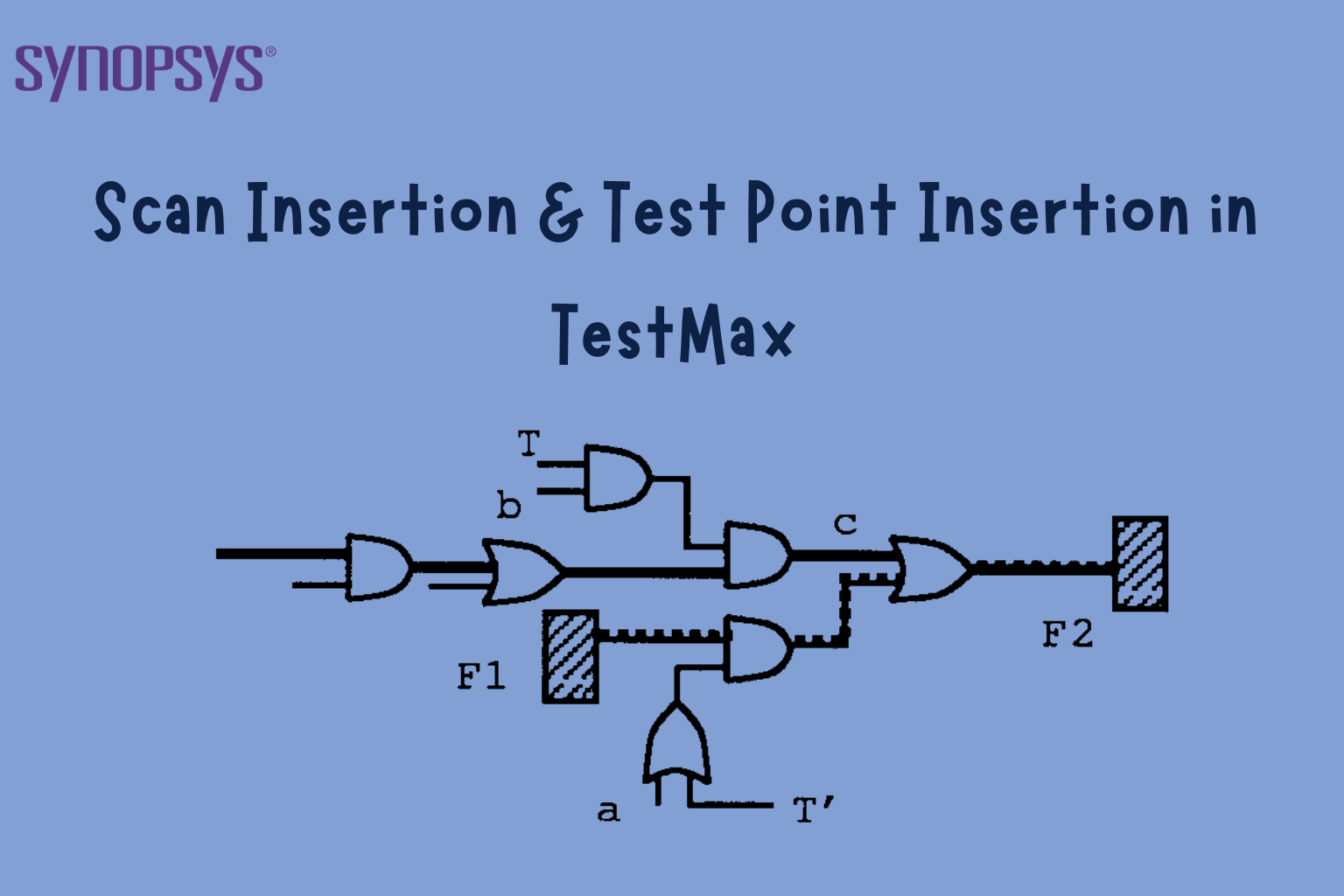
4. Test Point Insertion Concepts
4.1 Need for Test Point Insertion in DFT
4.2 Controllability and Observability Improvements
4.3 Types of Test Points (Control & Observation Points)
4.4 Test Point Insertion Strategy in TestMAX
4.5 Impact on Fault Coverage
5. Test Point Insertion Flow in TestMAX
5.1 Identification of Weakly-Testable Nodes
5.2 Automated Test Point Selection Algorithms
5.3 Insertion and Optimization Process
5.4 Constraint Handling and Design Trade-offs
5.5 Validation of Enhanced Coverage
6. DFT Rule Checking and Validation
6.1 DRC Checks for Scan Compliance
6.2 Test Point Impact Analysis
6.3 Scan Chain Integrity Verification
6.4 Fault Coverage Estimation
6.5 Debugging Common DFT Issues
7. Debugging Scan and Test Point Issues
7.1 Scan Chain Break Debugging
7.2 Clock and Reset Related Issues
7.3 Test Point Misconfiguration Debug Flow
7.4 Simulation-Based Debugging Techniques
7.5 Repair and Re-insertion Strategies
8. Signoff and Quality Metrics
8.1 Fault Coverage Metrics Analysis
8.2 ATPG Readiness Signoff Criteria
8.3 Scan Compression Efficiency Evaluation
8.4 Timing and Area Impact Assessment
8.5 Final DFT Closure Checklist
Conclusion
This training provides a complete understanding of scan insertion and test point insertion using Synopsys TestMAX. Moreover, it explains practical implementation and validation steps. In addition, it helps learners improve fault coverage and test efficiency.
Therefore, learners can build high-quality and testable designs. As a result, they can achieve production-ready digital designs with optimized test cost.



Reviews
There are no reviews yet.