


Description
Introduction
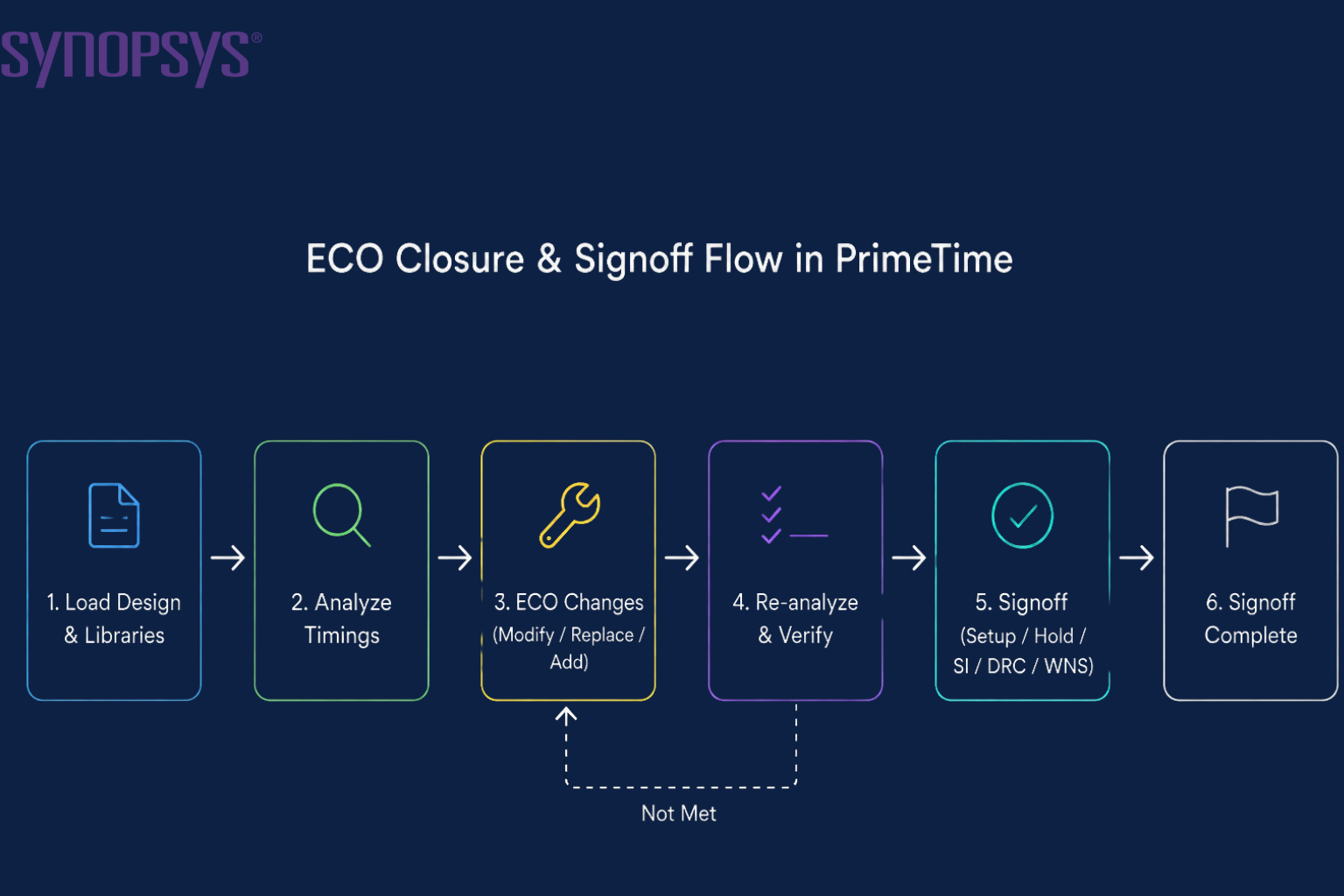
Synopsys PrimeTime is an industry-standard static timing analysis (STA) tool. It is used for timing verification, ECO implementation, and final signoff in advanced VLSI designs. Moreover, it helps engineers analyze setup, hold, noise, and power-related timing issues. These analyses are performed across multiple modes and corners.
Therefore, PrimeTime plays a critical role in achieving timing closure. In addition, it ensures silicon reliability before tapeout.
Learner Prerequisites
- Basic understanding of digital electronics and VLSI design flow
- Familiarity with static timing analysis (STA) concepts such as setup, hold, and clock domains
- Knowledge of timing constraints (SDC) and timing reports
- Exposure to Unix/Linux environment and scripting basics
- Prior experience with synthesis or place-and-route tools is beneficial
Table of Contents
1. Introduction to ECO Closure and Signoff Flow
1.1 Overview of ECO Concepts in VLSI Design
1.2 Importance of ECO in Timing Closure
1.3 Types of ECOs: Functional, Timing, Power, and Physical
1.4 ECO Flow within the Signoff Methodology
1.5 Challenges in Late-Stage ECO Implementation
2. PrimeTime Environment for ECO Closure
2.1 PrimeTime Setup for ECO Analysis
2.2 Design Import and Timing Environment Setup
2.3 Library, Parasitics, and Constraints Integration
2.4 Multi-Mode Multi-Corner (MCMM) Setup for ECO
2.5 Validating Pre-ECO Timing Conditions
3. Timing Analysis for ECO Identification
3.1 Identifying Setup and Hold Violations
3.2 Path-Based vs Graph-Based Analysis
3.3 Critical Path Extraction Techniques
3.4 Analyzing Slack Distribution and Bottlenecks
3.5 Debugging Timing Violations Efficiently
4. ECO Techniques for Timing Closure
4.1 Gate Sizing and Cell Replacement
4.2 Buffer Insertion and Removal Strategies
4.3 Logic Restructuring and Re-synthesis
4.4 Fixing Setup Violations
4.5 Fixing Hold Violations
5. Advanced ECO Strategies
5.1 ECO Optimization under MCMM Conditions
5.2 Crosstalk and Noise-Aware ECO Fixes
5.3 Power-Aware ECO Techniques
5.4 Leakage and Dynamic Power Considerations
5.5 Managing ECO Impact on Area and Congestion
6. PrimeTime ECO Commands and Automation
6.1 Overview of ECO-Specific Commands in PrimeTime
6.2 Automated ECO Flow using Scripting
6.3 Using Incremental Timing Analysis
6.4 Generating ECO Change Lists
6.5 Verification of ECO Changes
7. Integration with Physical Design Flow
7.1 ECO Handoff to Place-and-Route Tools
7.2 Back-Annotation and Parasitic Updates
7.3 Ensuring Physical Feasibility of ECO Fixes
7.4 Iterative ECO Loop between STA and PnR
7.5 Best Practices for ECO Implementation
8. Signoff Checks and Validation
8.1 Final Timing Signoff Criteria
8.2 Setup, Hold, and Recovery/Removal Closure
8.3 Signal Integrity and Crosstalk Validation
8.4 Power and Leakage Signoff Checks
8.5 Consistency Checks Across Corners and Modes
9. Debugging and Troubleshooting ECO Issues
9.1 Common ECO Failures and Root Cause Analysis
9.2 Resolving Conflicting Timing Fixes
9.3 Handling Unfixable Violations
9.4 Debugging Constraint Issues
9.5 Ensuring Design Stability Post-ECO
10. Best Practices for ECO Closure
10.1 Minimizing ECO Iterations
10.2 Maintaining Design Integrity
10.3 Documentation and Version Control
10.4 Collaboration Across Design Teams
10.5 Checklist for Successful ECO Closure
11. Case Studies and Real-World Scenarios
11.1 ECO Closure for Setup Violations
11.2 ECO Closure for Hold Violations
11.3 MCMM ECO Challenges and Solutions
11.4 Power vs Timing Trade-off Scenarios
11.5 Lessons Learned from Tapeout Projects
12. Advanced Signoff Flow Techniques
12.1 Variation-Aware Signoff (OCV, AOCV, POCV)
12.2 Statistical Timing Analysis in ECO
12.3 Multi-Voltage and Low-Power Signoff
12.4 ECO in Advanced Nodes (7nm and below)
12.5 Future Trends in ECO Automation
Conclusion
This training provides a comprehensive understanding of ECO closure and signoff flow using PrimeTime. Moreover, it covers violation identification, optimization, and final validation. In addition, it helps learners understand advanced ECO techniques.
Therefore, learners can efficiently close timing and reduce iterations. As a result, they can ensure robust and reliable chip signoff in modern VLSI design flows.



Reviews
There are no reviews yet.