


Description
Introduction
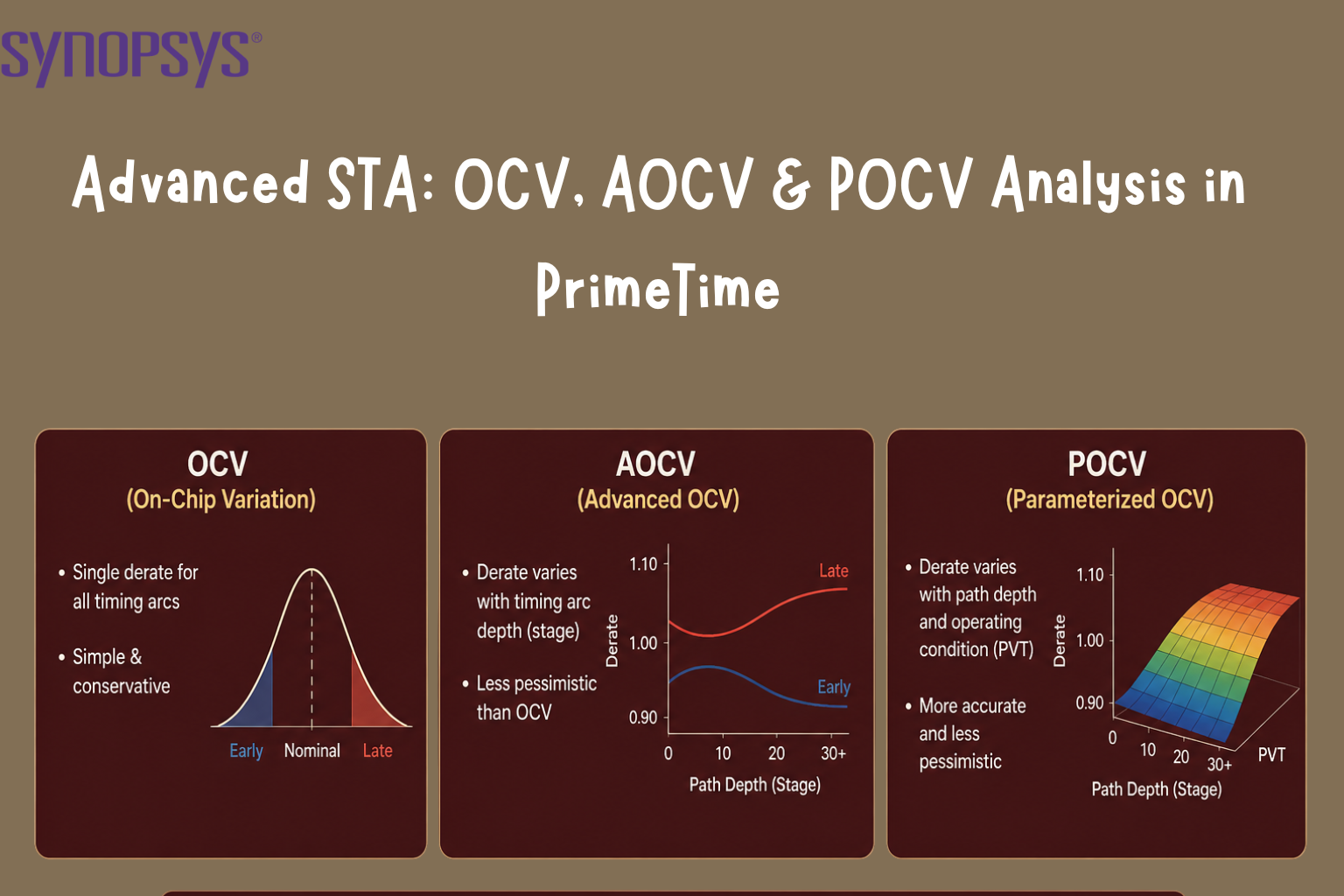
Synopsys PrimeTime is a widely used Static Timing Analysis (STA) solution for signoff verification. It analyzes timing across multiple PVT corners. Moreover, it supports advanced variation models like OCV, AOCV, and POCV. As a result, it helps designers achieve reliable timing closure in advanced nodes. In addition, it improves accuracy by accounting for on-chip variations.
Learner Prerequisites
- Basic understanding of Static Timing Analysis (STA) concepts
- Familiarity with setup, hold, and clock timing checks
- Knowledge of digital design fundamentals and timing paths
- Experience with PrimeTime basics and timing reports
- Understanding of process variations and PVT corners
Table of Contents
1. Fundamentals of On-Chip Variation (OCV)
1.1 Introduction to Process Variations and Their Impact on Timing
1.2 Sources of Variation in Advanced Nodes
1.3 Global vs Local Variations
1.4 OCV Concepts and Derating Techniques
1.5 Setup and Hold Derates in OCV
1.6 Limitations of Traditional OCV Models
2. Advanced OCV (AOCV) Modeling and Analysis
2.1 Introduction to AOCV and Its Need
2.2 Depth-Based Derating Concepts
2.3 AOCV Table Structure and Interpretation
2.4 Applying AOCV in PrimeTime
2.5 AOCV for Setup and Hold Analysis
2.6 Debugging Timing with AOCV
2.7 Comparison Between OCV and AOCV
3. Parametric OCV (POCV) and Statistical Timing
3.1 Introduction to POCV and Statistical STA
3.2 Sigma-Based Variation Modeling
3.3 POCV Derate Computation and Usage
3.4 LVF (Liberty Variation Format) Overview
3.5 Applying POCV in PrimeTime
3.6 Correlation Between AOCV and POCV
3.7 Advantages of POCV in Advanced Nodes
4. Multi-Corner Multi-Mode (MCMM) with Variation Models
4.1 MCMM Fundamentals with OCV/AOCV/POCV
4.2 Scenario Setup for Variation Analysis
4.3 Constraint Management Across Corners
4.4 Variation Impact on Setup/Hold Across Modes
4.5 Optimization Strategies for MCMM
5. Variation-Aware Timing Closure Techniques
5.1 Identifying Critical Paths Under Variation
5.2 Fixing Setup Violations with Derates
5.3 Hold Fixing Strategies Under OCV/AOCV/POCV
5.4 Buffer Insertion and Gate Sizing Techniques
5.5 Trade-offs Between Timing, Power, and Area
6. PrimeTime Commands and Flow for Variation Analysis
6.1 Setting OCV/AOCV/POCV Derates
6.2 Reading AOCV and LVF Files
6.3 Reporting Timing with Variation Models
6.4 Debugging Violations Using Reports
6.5 Automation and Scripting Best Practices
7. Signoff Considerations and Best Practices
7.1 Choosing the Right Variation Model
7.2 Correlation with Silicon and Foundry Data
7.3 Signoff Criteria for Advanced Nodes
7.4 Common Pitfalls and Debug Techniques
7.5 Industry Best Practices for Robust STA
Conclusion
This training explains OCV, AOCV, and POCV in a structured way. Moreover, it focuses on practical usage in PrimeTime. In addition, it highlights variation-aware timing closure techniques. As a result, learners can analyze timing more accurately. Therefore, they can handle timing challenges in advanced nodes with confidence.



Reviews
There are no reviews yet.