


Description
Introduction
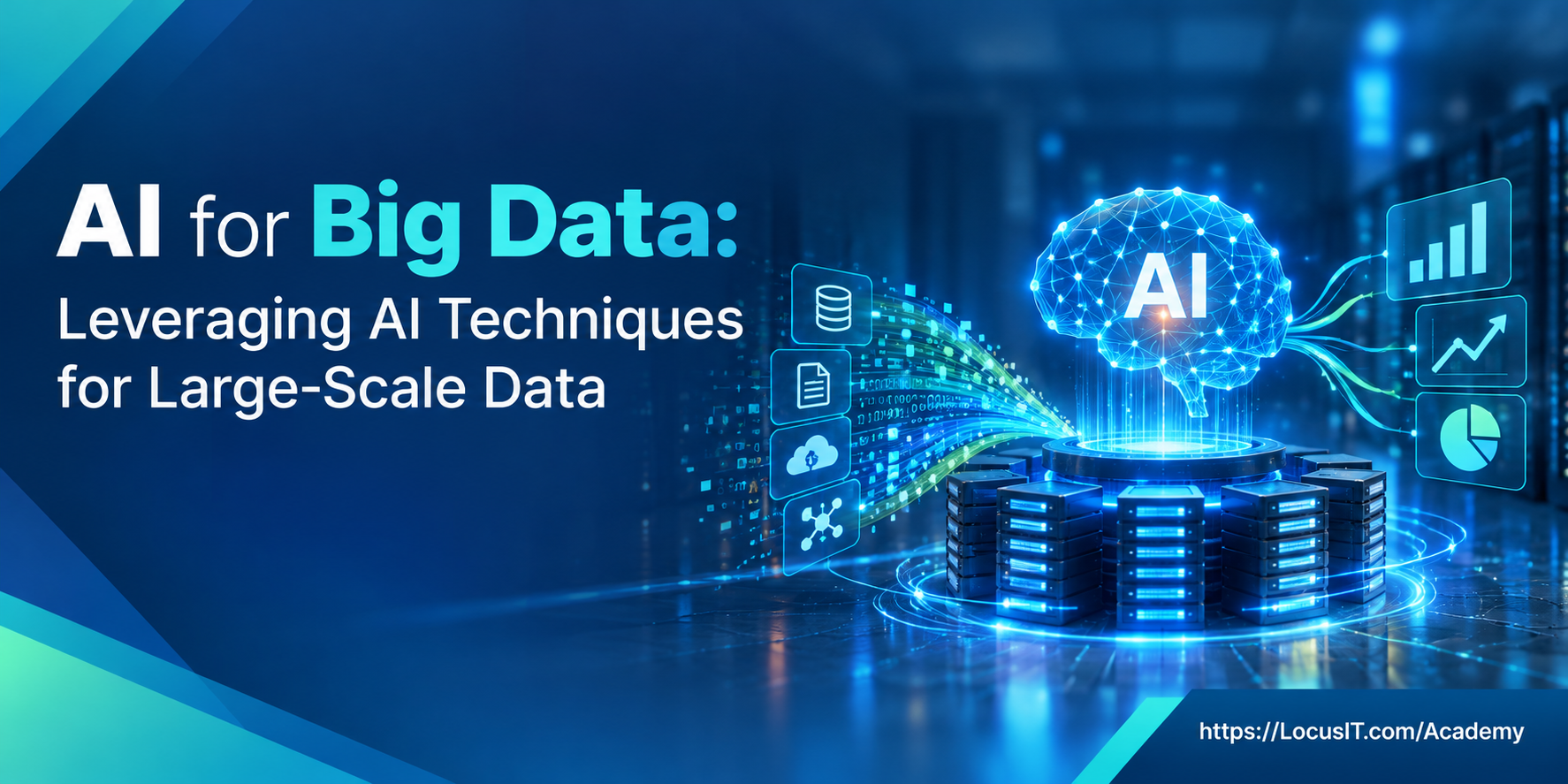
“AI for Big Data: Leveraging AI Techniques for Large-Scale Data” is a specialized course designed to explore how artificial intelligence (AI) techniques can be applied to manage, analyze, and extract insights from large-scale data sets. This course covers the integration of AI and big data technologies, focusing on practical applications and advanced methods for handling massive amounts of data. Participants will learn about data processing frameworks, scalable AI algorithms, and real-world use cases of AI in big data environments. The course combines theoretical knowledge with hands-on exercises, preparing learners to deploy AI solutions that can efficiently process and analyze large-scale data.
Prerequisites
-
Basic knowledge of artificial intelligence and machine learning.
-
Familiarity with Python programming.
-
Understanding of databases and SQL.
-
Knowledge of statistics and data analysis.
-
Basic understanding of big data concepts and distributed systems.
-
Familiarity with cloud computing is beneficial.
Estimated Duration
-
Beginner Level: 2–3 days
-
Intermediate Level: 4–5 days
-
Advanced Level: 5–7 days
-
Enterprise Level: 8–10 days
Training Lab Setup Specifications
-
Laptop or desktop with at least 16 GB RAM recommended.
-
Windows, Linux, or macOS operating system.
-
Python 3.10 or later.
-
Jupyter Notebook or JupyterLab.
-
Visual Studio Code or PyCharm.
-
Python libraries: NumPy, Pandas, Scikit-learn, and TensorFlow or PyTorch.
-
Apache Hadoop and Apache Spark environments.
-
Apache Kafka for real-time data streaming exercises.
-
SQL database and NoSQL database environment.
-
Access to AWS, Microsoft Azure, or Google Cloud.
-
Sample large-scale datasets for practical exercises.
-
Git for version control.
-
Stable internet connection.
TABLE OF CONTENTS
Module 1: Introduction to AI for Big Data
1.1 Fundamentals of Big Data
1.1.1 Definition and characteristics of big data
1.1.2 Volume, velocity, variety, veracity, and value
1.1.3 Structured, semi-structured, and unstructured data
1.2 Artificial Intelligence and Big Data Integration
1.2.1 Role of AI in large-scale data analytics
1.2.2 Relationship between big data, machine learning, and AI
1.2.3 Business applications of AI-driven big data solutions
Module 2: Big Data Architecture and Technologies
2.1 Big Data Processing Fundamentals
2.1.1 Distributed computing and parallel processing
2.1.2 Batch processing and stream processing
2.1.3 Data lakes, data warehouses, and lakehouses
2.2 Big Data Technology Ecosystem
2.2.1 Apache Hadoop and Hadoop Distributed File System
2.2.2 Apache Spark and distributed data processing
2.2.3 NoSQL databases and distributed storage systems
Module 3: Data Collection, Integration, and Preparation
3.1 Large-Scale Data Collection
3.1.1 Data ingestion from multiple sources
3.1.2 APIs, databases, sensors, and streaming data
3.1.3 Data integration and transformation techniques
3.2 Data Preparation and Quality Management
3.2.1 Data cleaning and preprocessing
3.2.2 Handling missing values and inconsistent records
3.2.3 Feature engineering and data transformation
Module 4: Machine Learning Techniques for Big Data
4.1 Machine Learning Fundamentals
4.1.1 Supervised and unsupervised learning
4.1.2 Classification and regression techniques
4.1.3 Clustering and dimensionality reduction
4.2 Scalable Machine Learning
4.2.1 Distributed machine learning algorithms
4.2.2 Model training on large-scale datasets
4.2.3 Hyperparameter tuning and model optimization
Module 5: Deep Learning for Large-Scale Data
5.1 Deep Learning Fundamentals
5.1.1 Neural networks and deep learning architectures
5.1.2 Convolutional and recurrent neural networks
5.1.3 Transformer models and attention mechanisms
5.2 Distributed Deep Learning
5.2.1 GPU-based model training
5.2.2 Distributed training and parallel computing
5.2.3 Model optimization and resource management
Module 6: AI-Powered Big Data Analytics
6.1 Intelligent Data Analytics
6.1.1 Exploratory data analysis using AI techniques
6.1.2 Pattern recognition and anomaly detection
6.1.3 Predictive and prescriptive analytics
6.2 Advanced Analytical Applications
6.2.1 Natural language processing for unstructured data
6.2.2 Computer vision and image analytics
6.2.3 Recommendation systems and customer analytics
Module 7: Real-Time Data Processing and AI Streaming
7.1 Real-Time Data Architecture
7.1.1 Stream processing concepts and architecture
7.1.2 Apache Kafka and event-driven data pipelines
7.1.3 Real-time data ingestion and transformation
7.2 AI for Streaming Analytics
7.2.1 Real-time machine learning predictions
7.2.2 Streaming anomaly detection
7.2.3 Low-latency analytics and decision-making
Module 8: Cloud-Based Big Data and AI Platforms
8.1 Cloud Big Data Infrastructure
8.1.1 AWS, Microsoft Azure, and Google Cloud data services
8.1.2 Cloud storage and distributed processing
8.1.3 Scalable data engineering environments
8.2 Cloud-Based AI and Machine Learning
8.2.1 Managed machine learning platforms
8.2.2 Cloud-based model training and deployment
8.2.3 Data pipeline automation and orchestration
Module 9: MLOps, Model Deployment, and Monitoring
9.1 Machine Learning Operations
9.1.1 ML lifecycle management and automation
9.1.2 Model versioning and experiment tracking
9.1.3 Continuous integration and deployment for ML
9.2 Model Deployment and Performance
9.2.1 Deploying AI models in distributed environments
9.2.2 Model monitoring and performance evaluation
9.2.3 Model drift detection and retraining strategies
Module 10: Big Data Security, Governance, and Optimization
10.1 Data Security and Governance
10.1.1 Data privacy and access control
10.1.2 Data quality and governance frameworks
10.1.3 Regulatory compliance and responsible AI
10.2 Performance and Cost Optimization
10.2.1 Optimizing distributed data processing
10.2.2 Managing storage and computing resources
10.2.3 Improving AI model efficiency and scalability
Module 11: Practical Projects and Enterprise Applications
11.1 AI and Big Data Implementation
11.1.1 Building an end-to-end big data processing pipeline
11.1.2 Developing a scalable machine learning solution
11.1.3 Implementing real-time predictive analytics
11.2 Enterprise Case Studies
11.2.1 AI-driven customer behavior analysis
11.2.2 Fraud detection using large-scale datasets
11.2.3 Developing an enterprise AI and big data solution
Conclusion
AI for Big Data Training provides practical knowledge of large-scale data processing, machine learning, deep learning, and intelligent analytics. Participants will learn how to combine AI techniques with distributed computing technologies to extract meaningful insights from complex datasets. Furthermore, they will explore real-time analytics, cloud platforms, and scalable model deployment. As a result, learners will be prepared to develop data-driven solutions for enterprise analytics, business intelligence, fraud detection, and predictive decision-making.

Reviews
There are no reviews yet.